


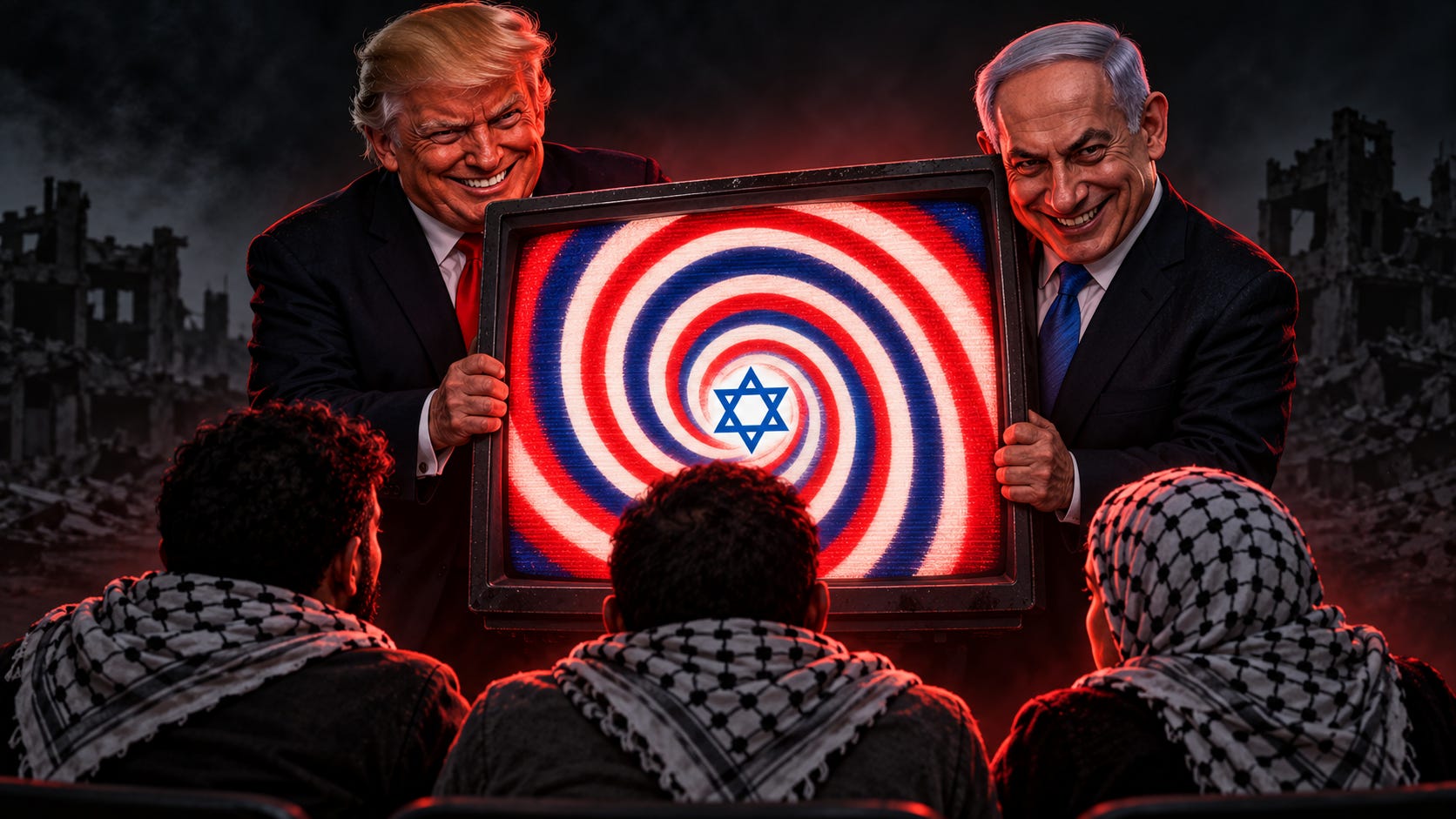
The US and Israel have plans for Gaza’s survivors. Apparently, surviving the destruction of their homes is no excuse for holding the “wrong” opinions. American and Israeli proposals would put schooling and religious life under outside supervision, control public debate and promote more agreeable Palestinian leaders. Reconstruction money would help encourage cooperation. They call it “deradicalization.” A generous offer: Washington and Israel would help rebuild Gaza and spare its people the inconvenience of deciding what to believe.
On Oct. 9, The Associated Press reported that an American charity was already rewriting Palestinian textbooks and testing artificial intelligence to monitor classroom conversations, with flagged remarks potentially costing teachers their jobs. Separate blueprints call for replacing thousands of educators, regulating mosque sermons, directing media campaigns and promoting new political leaders. The broader governance arrangements, however, remain unimplemented.
Point 18 of President Donald Trump’s peace plan calls for changing the “mindsets and narratives of Palestinians and Israelis.” A February 2026 memorandum from Israel’s Institute for National Security Studies (INSS) outlines a far more extensive vision of postwar transformation.
Plans to Replace Palestinian Teachers and Rewrite School Textbooks
The destruction of Palestinian schools by Israeli forces presents an “extraordinary opportunity for reform,” according to a 2024 policy paper by the US Israel Education Association (USIEA), an American organization working with members of Congress. Its proposed Alternate Gazan Education System (AGES) would replace existing educational institutions and remove the United Nations Relief and Works Agency for Palestine Refugees (UNRWA), which educated nearly 300,000 children before the war.
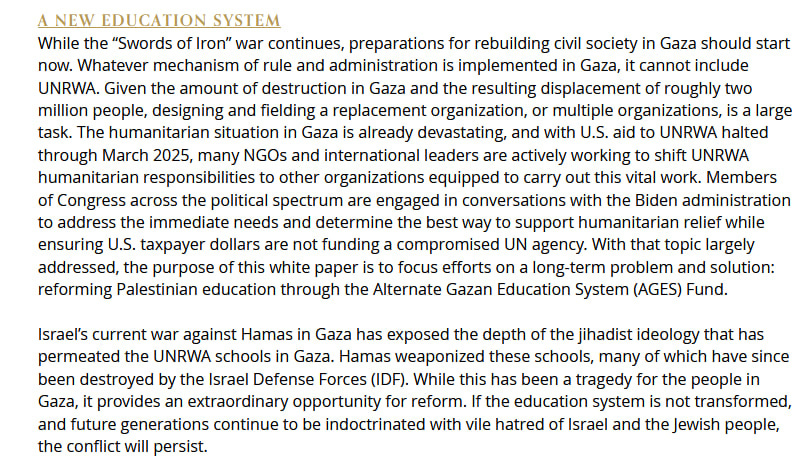
Under AGES, a coalition of Western governments, Israel and Arab countries that have normalized relations with it would oversee schooling from the elementary level through university. The Palestinian Authority could participate only after fundamental reforms, with Israel avoiding a formal leadership role to escape accusations of renewed occupation. Israeli representatives could still flag textbook content they considered objectionable, but the coalition would make the final decisions.
Saudi or Emirati textbooks could form the basis of the curriculum, with the proposed changes extending to vocational and higher education. USIEA suggests using part of a $3.495 billion US appropriation for emergency humanitarian assistance under a 2024 law to finance the project, but no such allocation has been confirmed. The document assumes Israeli forces could remain in the territory for years and argues that the US would need a more aggressive policy toward Iran to secure Gulf participation.
The system would replace most of UNRWA’s nearly 9,500 education employees. Recruits would face security checks, psychological assessments, continuous screening, mandatory “Education Towards Coexistence” training, regular inspections and zero-tolerance disciplinary rules. Teachers from the United Arab Emirates, Morocco and Bahrain could serve for up to four years to avoid adopting the “old way,” while Palestinians living abroad would be trained to join the new workforce.
An American charity called Gaza Children Village is already rewriting Palestinian textbooks under the leadership of David Hasan, a Palestinian American neurosurgeon at Duke University. At an Oct. 8 event hosted by NGO Monitor at Israel’s Reichman University, he said the charity’s Academies of Hope operated 21 schools serving roughly 22,000 children, providing food and medical care alongside lessons introduced without the Palestinian Authority’s approval. An Israeli businessman reportedly helped keep six of those academies operating when a funding shortfall threatened their closure.
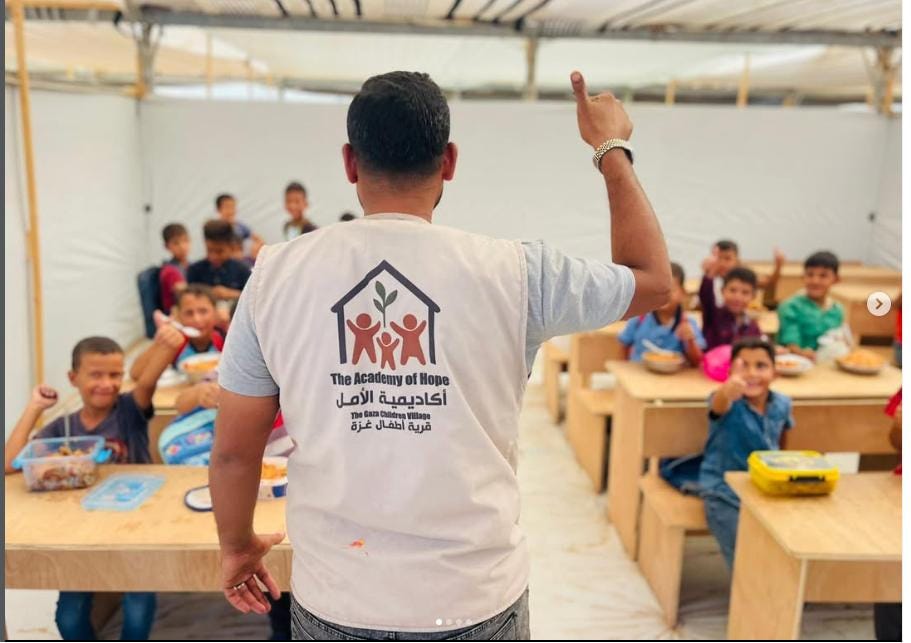
On Oct. 9, The Associated Press reported that the organization was testing artificial intelligence to monitor classroom conversations for statements classified as antisemitic, hateful or inciting. The technology would store recordings for 72 hours and forward flagged passages and transcripts to Hasan, who could fire teachers if he considered the detected remarks unacceptable. He claimed alerts could arrive within roughly 20 minutes, although widespread deployment has not been confirmed.
Hasan identified New York-based PollyLabs as a development partner, but the nonprofit denied any involvement in the technology. Bishara Bahbah, a board member of Hasan’s charity, told AP he had not been informed of the surveillance plans, and a partner aid group warned that recording lessons could jeopardize cooperation. Ines Abdel Razek, co-director of the Palestine Institute for Public Diplomacy, accused the initiative of trying to control the minds of new generations, questioning why an American charity should have such influence over Palestinian education. Israel has used AI to analyze intercepted communications and identify suspected military targets in the enclave, though there is no evidence the charity plans to share classroom recordings with Israeli authorities.
Math problems counting Palestinians killed during the first and second intifadas, or uprisings, have given way to exercises about soccer players and fans. A question calculating the trajectory of a projectile aimed at an Israeli soldier was rewritten as an Olympic javelin exercise, while a passage about Dalal Mughrabi, who led a deadly 1978 attack on Israeli civilians, was replaced with a text about Palestinian educator Hind al-Husseini.
An Islamic studies excerpt about Jews attempting to kill the Prophet Muhammad was rewritten to emphasize his respect for them. The revised curriculum includes Jewish history and the displacement of these communities from Arab countries alongside the Nakba, the mass uprooting of Palestinians in 1948. Maps explicitly identify Israel, although some lessons refer to the country simply as “neighbor.” The Jewish Chronicle described the material as the “first-ever pro-Israel curriculum in Gaza or the West Bank,” reporting that Hasan avoids public discussion of its contents to maintain local support.
Hasan’s organization screens prospective teachers through Israel’s Coordinator of Government Activities in the Territories (COGAT), the military body overseeing civilian affairs in the enclave, as well as American counterterrorism checks. Former Hamas and UNRWA employees are barred, and applicants must complete a psychological questionnaire containing nearly 50 items about violence, empathy and revenge. Hasan says researchers at Stanford University helped develop the assessment.
Candidates classified as hateful, resentful or revenge-driven are rejected. Jason Olson, a former deradicalization official on Trump’s Board of Peace, says one in three applicants from the previous education system fails the assessment. Those who pass still face unannounced remote classroom inspections by consultants.
The charity is developing cartoons about religion, empathy and social values, with the first episode planned for November. Its founder has proposed using Xbox and Nintendo games to teach cooperation and Holocaust history, mentioning possible US Embassy involvement without explaining what role it would play. He wants Palestinian children to become global citizens capable of assimilating abroad, but denies seeking to erase their identity.
By September 2026, 98% of Gaza’s schools had been damaged or destroyed, disrupting education for roughly 700,000 children over nearly three years, according to UNICEF. More than 500,000 began returning to classes, many in tents and damaged buildings, while another 200,000 still lacked access to structured learning. Palestinian officials reported approximately 22,000 students and 532 teachers killed, as families struggled to afford basic school supplies. Amid this devastation, US-linked efforts to replace the existing public education system stand alongside private academies already rewriting textbooks and testing AI surveillance. Whoever sets the curriculum and appoints teachers will wield enormous influence over how the next generation understands Palestinian history and national identity.
The Push to Control Palestinian Mosques and Sermons
US and Israeli policy documents envision placing Islamic institutions and charities under an internationally supervised administration. Arab governments could occupy senior positions, with Israel retaining a seat in the oversight structure. Presented as “deradicalization,” the arrangements would determine who is authorized to preach, what can be said from the pulpit and how religious donations are monitored.
A December 2025 roadmap from Israel’s Institute for National Security Studies (INSS) calls for monitoring mosque activities and sermons, cracking down on statements classified as incitement and involving the United Arab Emirates in reshaping Palestinian society. It advocates cultivating moderate clerics to lend legitimacy to efforts against extremism.
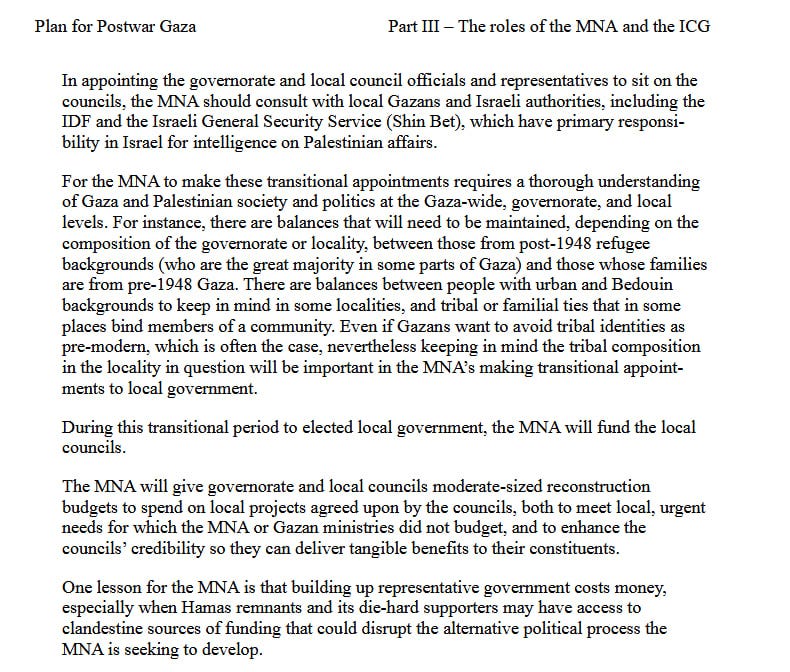
The Wilson Center’s May 2024 report, “Plan for Postwar Gaza,” outlines a separate administrative blueprint. Written by former senior US officials alongside Eran Lerman, Israel’s former deputy national security adviser, and shared with designated Israeli government agencies, it proposes transferring supervision of places of worship and social organizations to a Multinational Authority. Annex I, Section 6, urges the adoption of preaching guidelines “radically different” from Hamas-sponsored sermons before Oct. 7, 2023.
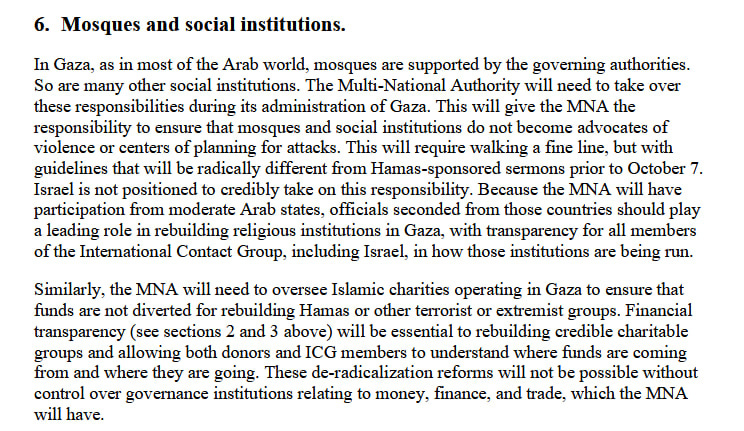
The authors acknowledge that direct Israeli management of Palestinian religious institutions would lack credibility. They favor appointing Arab representatives to senior positions, with Israel retaining a seat on the International Contact Group overseeing the administration. Israeli officials would receive information about mosque operations, giving them continued access to the supervisory process without having to manage Palestinian places of worship themselves.
Islamic charities would have to disclose donations to prevent money from reaching Hamas or other designated extremist groups. The report’s authors propose placing their finances under the Multinational Authority, whose powers would extend to Gaza’s banking, trade and government. Its administrators could scrutinize the flow of funds through religious organizations.
A July 2026 analysis by the Washington Institute for Near East Policy identifies Morocco as a possible source of the personnel and methods needed to regulate local Islamic institutions. Following the 2003 Casablanca bombings, the Moroccan government tightened its grip on mosques, placing the appointment and licensing of imams, religious funding, endowments and sermon regulation under its Ministry of Islamic Affairs. Preachers must complete state-approved training and pass official examinations.
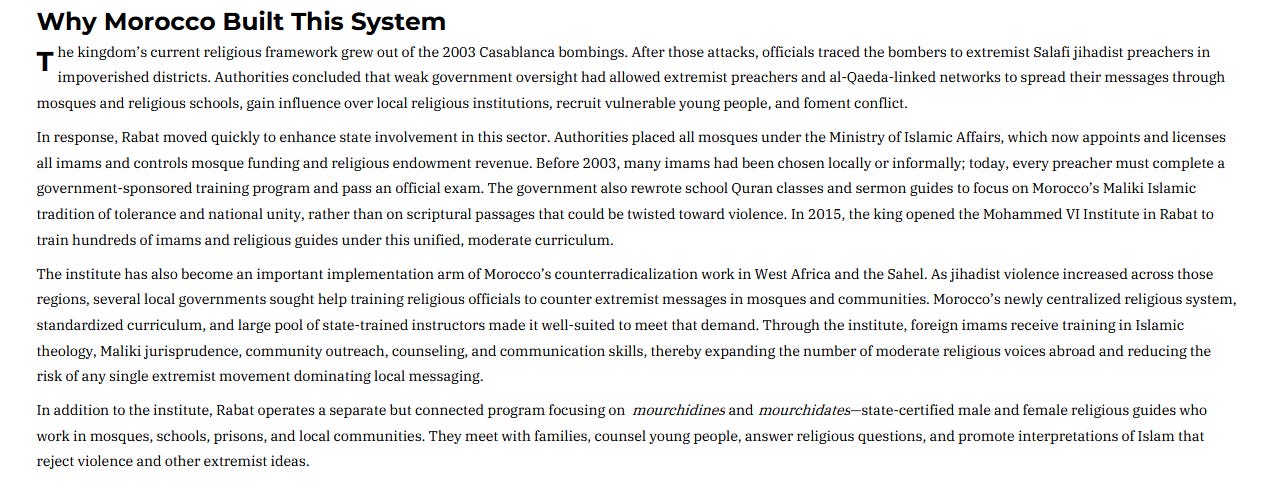
Under this centralized system, Quranic instruction and preaching were standardized around state-approved interpretations of Islam. By late 2022, the Mohammed VI Institute, established in 2015, had trained 2,798 foreign religious students. Washington Institute analyst Salma Annasse proposes using this model to train Palestinian administrators who would license imams, review Friday sermons and supervise places of worship. The theological differences would remain: Morocco follows the Maliki school of Islamic law; Shafi’i and Hanafi traditions predominate locally. These procedures could therefore be introduced without importing the kingdom’s religious doctrine wholesale.
Morocco’s relationship with Israel is among the reasons Annasse favors its involvement. She points to the country’s experience securing access for Palestinian projects through the Bayt Mal al-Quds Asharif Agency and the diplomatic channels opened by the Abraham Accords. Those ties could provoke suspicion among Palestinians, she acknowledges, while independent evidence of the system’s long-term effectiveness remains limited. Its original purpose was largely to counter Salafi jihadist movements, whereas Hamas emerged from the Muslim Brotherhood tradition.
Religious supervision could reach into homes, schools and family relationships. State-trained counselors of both sexes promote approved Islamic teachings in neighborhoods, educational institutions and prisons. The Wilson Center draws on Saudi rehabilitation programs in which respected relatives oversaw former militants, sometimes helping arrange employment or marriages. For fighters seeking reintegration, the authors recommend supervised family contact and programs based partly on Israeli assessments of captured or surrendered combatants, with the process carried out in consultation with Israel.
The National Committee for the Administration of Gaza (NCAG), established in January 2026 under President Donald Trump’s Board of Peace framework, could provide a channel for these reforms. The committee has a portfolio for religious services and Islamic endowments, temporarily overseen by chief commissioner Ali Shaath. The Washington Institute suggests it could receive Moroccan training, although no agreement has been approved and the NCAG has yet to take effective control of local mosques. Israeli forces still held roughly two-thirds of the territory as of October 2026.
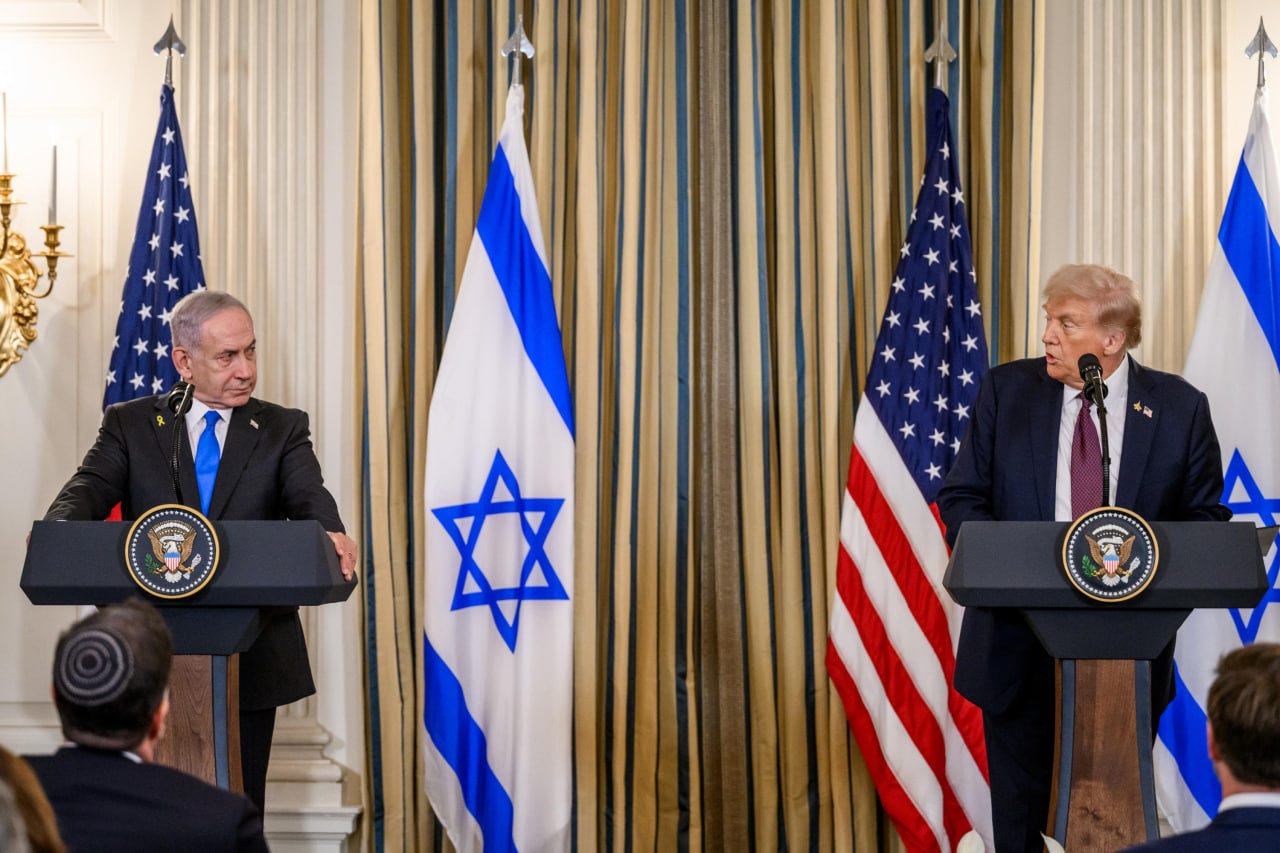
The proposed framework would extend foreign oversight far beyond religious institutions. American and Israeli policy papers envision restructuring the local media landscape, restricting communications and promoting political figures whose positions align with the objectives of the new governing system.
The Blueprint to Censor Gaza and Handpick Its Leaders
In an Oct. 17, 2025, paper, Neomi Neumann, former head of the research unit at Israel’s Shin Bet security agency, and Devorah Margolin of the Washington Institute for Near East Policy outline a strategy they call “agenda transformation.” The researchers recommend weakening support for Hamas and discouraging participation in future attacks.
They see reconstruction, personal security and economic opportunities as ways to shift public attitudes away from armed resistance. Success would be measured by people’s willingness to accept alternative leadership, cooperate with disarmament and refuse to assist with recruitment or weapons resupply. Citing Germany’s postwar denazification, they advocate changing institutions and social norms rather than focusing solely on individual rehabilitation.
Television channels and other outlets affiliated with the movement would be shut down, with a new regulatory authority operating under international supervision. The paper calls for intelligence operations to identify networks accused of spreading incitement, Palestinian legislation banning extremist content and foreign commitments to deny the group access to broadcasting platforms. All official government messaging would fall under the transitional administration, concentrating control over the territory’s public information system.
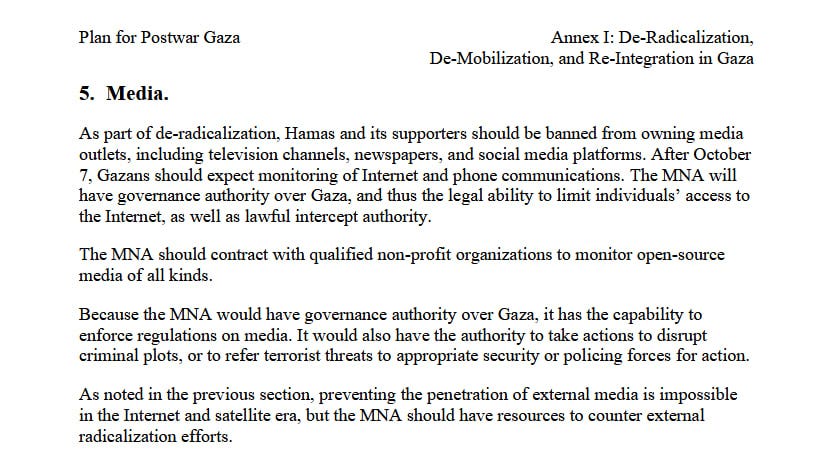
The May 2024 Wilson Center report, “Plan for Postwar Gaza,” goes further into individual surveillance. Its proposed Multinational Authority could restrict internet access, legally intercept telephone calls and online traffic, and hire nonprofit organizations to monitor publicly available content. The document would bar Hamas members and supporters from owning television stations, newspapers or social media outlets, extending external oversight into private communications and media ownership.
The report recommends dismantling or reorganizing Gaza’s information and communications ministry, citing the US-led occupation of Iraq in 2003 as a precedent. Its replacement would employ Arabic-speaking specialists, commission opinion polls and run campaigns on Telegram, Snapchat and other platforms to counter messages attributed to Hamas and Iran. The authors acknowledge that senior American officials often know little about these networks and suggest recruiting people familiar with Palestinian audiences.
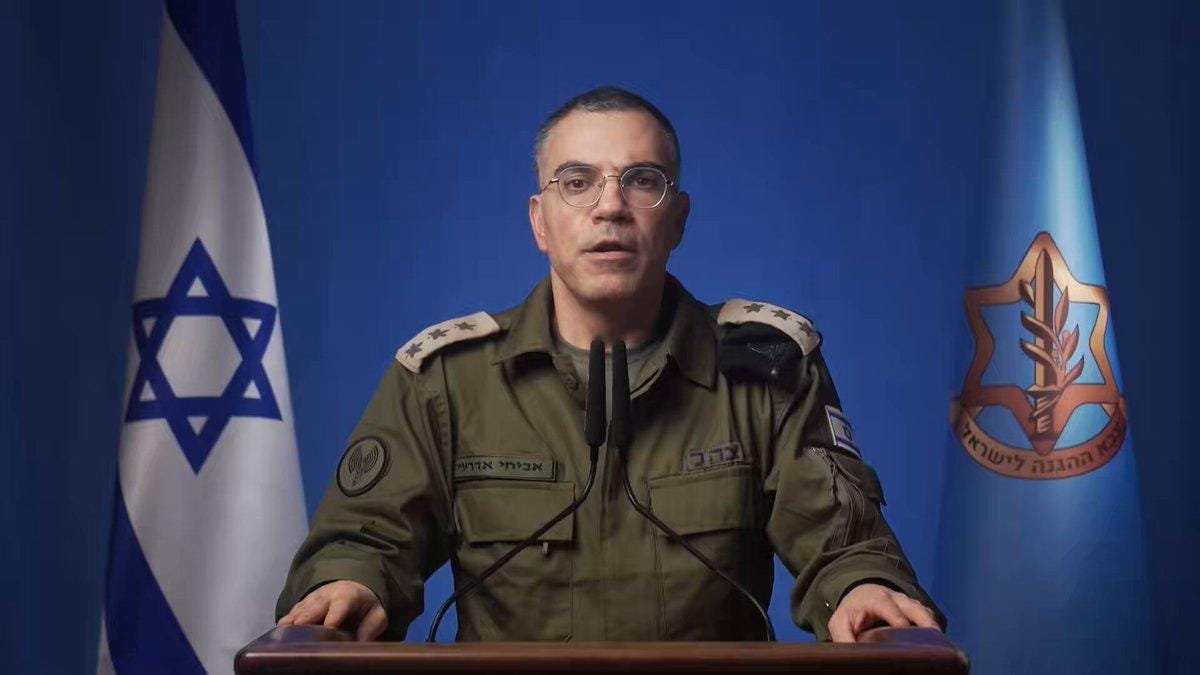
Israel already reaches Arabic-speaking audiences through military announcements, evacuation warnings and online content mixing satire with popular culture. On June 9, 2026, The Associated Press reported that military spokesman Avichay Adraee had attracted roughly 2.5 million followers, partly through videos mocking Hamas, including a parody portraying underground tunnels as a hotel. Adraee said social media lets him bypass Arab governments and speak directly to their populations, while many Palestinians associate his posts with approaching bombardment and displacement.
On Jan. 19, 2026, Israeli forces dropped evacuation leaflets over Bani Suhaila, east of Khan Younis, in the first reported operation of its kind since the October 2025 ceasefire. Issued in Arabic, Hebrew and English, the notices declared the area under Israeli military control, confronting residents with another demand to abandon their homes despite the formal truce.
An entire section of the Wilson Center document, titled “Telling the Palestinian people the hard truths,” outlines the version of history its authors want future local leaders to promote. They claim the more than 30,000 Palestinian deaths recorded when the report was written in 2024 could have been avoided had Hamas not attacked Israel on Oct. 7, 2023, and portray 75 years of armed resistance as a political failure. Rather than relying on American or Israeli officials to deliver these arguments, they recommend encouraging influential Palestinians to spread them within their own communities.
The Palestinian right of return, a central demand of refugees displaced from their homes and lands, is singled out for reconsideration. According to the report, a Palestinian state might already exist if negotiators in 2000 had reconciled refugee claims with existing land ownership in Israel. The authors portray reliance on a full-scale Hezbollah war or on Houthi attacks to sway foreign governments as strategic miscalculations.
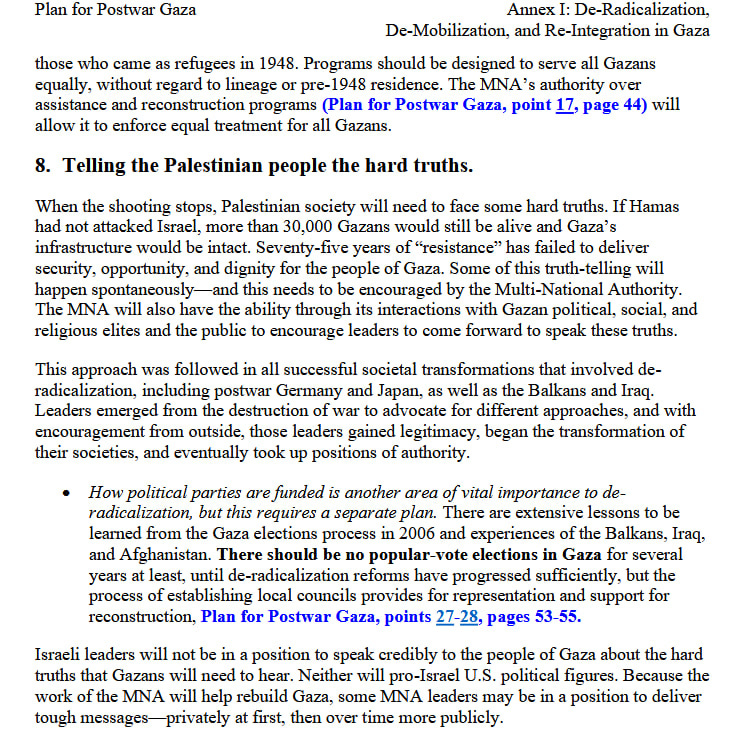
The report’s authors propose using reconstruction funds to promote Palestinian figures willing to advocate alternatives to armed struggle, drawing on examples from postwar Germany, Japan, Iraq and the Balkans. Government jobs, contracts, scholarships, awards and local council appointments could be distributed partly according to the political objectives of the deradicalization program. Initial officials would be selected across Gaza’s five governorates and 25 local administrative units following consultations with Palestinian representatives and Israeli authorities, including the military and Shin Bet. Those resources would help the new councils build public support, with territory-wide elections delayed for at least a year under the main proposal, or several years under its accompanying annex.
Neumann and Margolin suggest involving Saudi Arabia and the United Arab Emirates in the campaign, drawing on their regional media networks and experience with counterextremism messaging. The emphasis would be on security, economic recovery and social welfare rather than overt religious reeducation.
As of October 2026, the proposed communications authority and political appointment system had not been established, although Israel continued its Arabic-language military messaging. The American policy documents nevertheless spell out how a future administration could restrict Palestinian speech, involve Israeli security agencies in selecting local leaders, postpone elections and allocate recovery funding according to its political priorities.
How Israel Seeks to Rebuild Gaza in Its Own Image
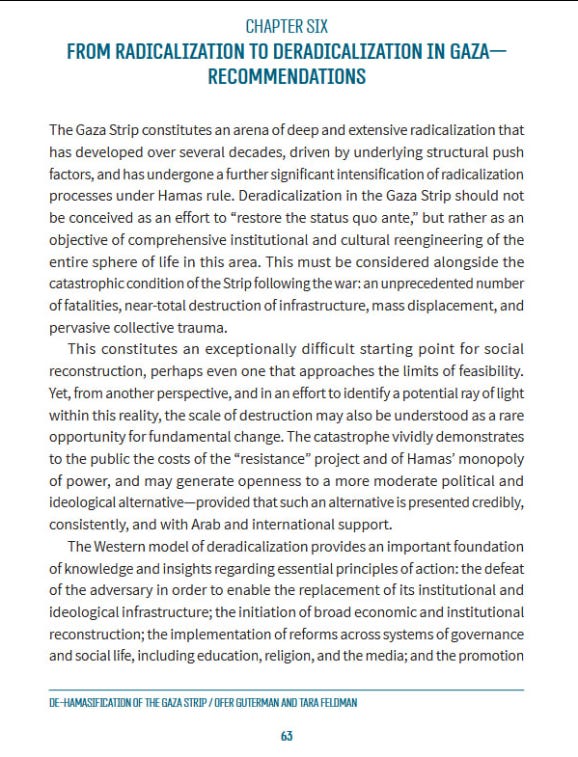
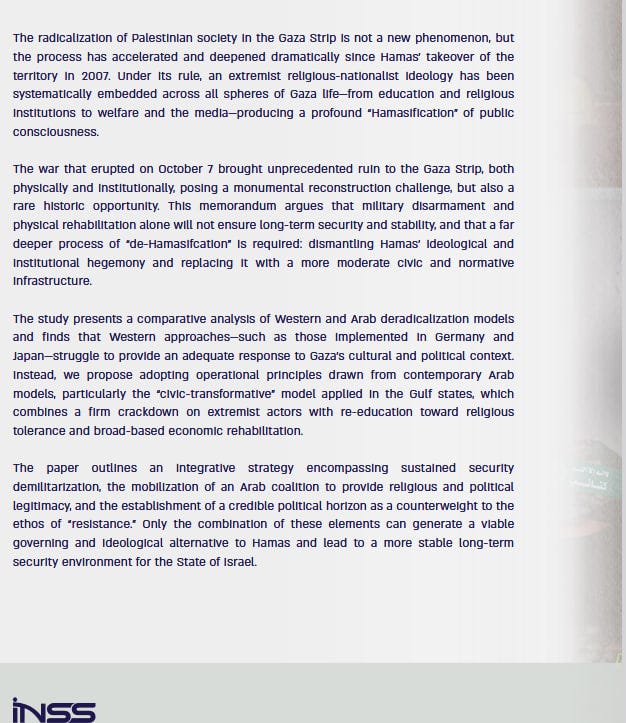
The Institute for National Security Studies (INSS), an Israeli think tank, describes the devastation as a “rare historic opportunity” to fundamentally reshape Palestinian society. In a February 2026 memorandum titled “De-Hamasification of the Gaza Strip: Learning from Western and Arab Models of Deradicalization,” researchers Ofer Guterman and Tara Feldman call for “comprehensive institutional and cultural reengineering.” The overhaul they envision would reach into political beliefs, religious practices, public institutions and the way Palestinians understand their national identity.
They argue that the suffering inflicted by the war could force Palestinians to confront what they call the costs of the “resistance” project. They expect military defeat, mass displacement and the collapse of civilian infrastructure to weaken support for Hamas and increase acceptance of alternative political leadership. The war’s human toll thus becomes a factor in their calculations about changing the convictions of Gaza’s surviving population.
Rather than adopting the American-led models used in postwar Germany, Japan and Iraq, the memorandum favors approaches developed by Saudi Arabia and the United Arab Emirates. These approaches combine coercive security measures, surveillance, state-directed religious instruction and economic incentives with efforts to elevate official authority above competing ideological loyalties. INSS explicitly calls for challenging the “ethos of resistance,” while Arab governments would lend political legitimacy and theological backing to a program ultimately intended to strengthen Israel’s security.
INSS proposes using reconstruction to consolidate the new political order, warning that restoring infrastructure in territory still governed by Hamas could strengthen its standing among residents. If the group refuses to disarm, the authors suggest restricting rebuilding to demilitarized areas outside its control, even as they acknowledge the dangers of delaying civilian recovery. Access to funding would therefore become another factor in the struggle over Gaza’s future leadership.
Employment and functioning public services would help replacement authorities gain the population’s confidence. INSS recommends delivering visible improvements quickly, using the resulting trust to advance deeper changes in identity and social norms. Palestinians would take part in rebuilding their communities, with the recovery process designed to establish the political alternative the authors want them to accept.
To prevent the movement from regaining influence, the memorandum calls for purging its operatives from governing bodies, establishing new legal safeguards and applying transparency requirements to public appointments. Courts, welfare agencies and other bodies would be reorganized, alongside measures to remove content classified as extremist or inciting from online platforms.
The initiative would extend into families, clans and community organizations, reaching beyond government offices. INSS identifies three interconnected levels of intervention: individuals receiving counseling and rehabilitation, local networks reinforcing approved behavior, and state institutions embedding the new rules. The researchers argue that these interventions must be coordinated to prevent gaps that could undermine the strategy.
A mandatory body of sermons and Islamic rulings would reject messages classified as extremist and emphasize prescribed civic obligations. Clerics from Arab countries would help train Gaza’s preachers and legitimize the new guidance, bringing state-approved interpretations of Islam into the broader campaign to change Palestinian political and social attitudes.
Popular entertainment would become another instrument, with INSS proposing articles, television series, dramas and satire distributed through traditional and digital media. These productions would promote nonviolent resistance and respect for the rule of law as defining elements of a “modern Palestinian identity,” reaching audiences beyond classrooms, mosques and official communications.
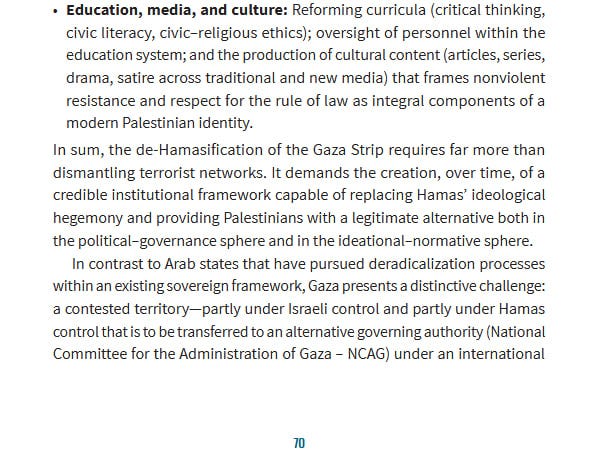
The memorandum recommends regional trauma treatment centers, vocational training and dedicated rehabilitation programs for women and young people. Families and local communities would enter agreements supporting disengagement from extremist organizations, while graduated incentives would encourage reintegration. Former members could qualify for conditional amnesty under criteria defined by Israel, preserving an Israeli role in determining who could return to civilian life and under what conditions.
INSS proposes evaluating the campaign through key performance indicators, public opinion surveys, field research and social media monitoring. These assessments would track support for political violence, identify online material classified as incitement and test whether armed resistance was losing its appeal. Palestinian beliefs and behavior would become the yardstick for judging success.
The authors acknowledge that Palestinians would need a credible path toward independence and sovereignty, although progress could remain restricted by Israeli security requirements. They also recognize that denying them the right to pursue political goals would undermine the entire effort. Yet the proposed transformation would unfold under continued demilitarization, Arab-backed governance and security arrangements designed to prevent Hamas from returning, with Israel’s long-term safety identified as the ultimate strategic objective.
The American and Israeli policy papers examined in this investigation were developed by separate organizations, with no evidence that their recommendations have been adopted as a unified government program. The documents nevertheless outline overlapping mechanisms for bringing Gaza’s schools, mosques, public communications and leadership appointments under external control. The INSS memorandum portrays the rebuilding process as a means of reshaping Palestinian beliefs, social norms and attitudes toward resistance.
Under these blueprints, teachers, clerics and officials would operate within systems shaped by outside powers. Decisions about staffing, government messaging and reconstruction funding could become tools for enforcing the new administration’s agenda.
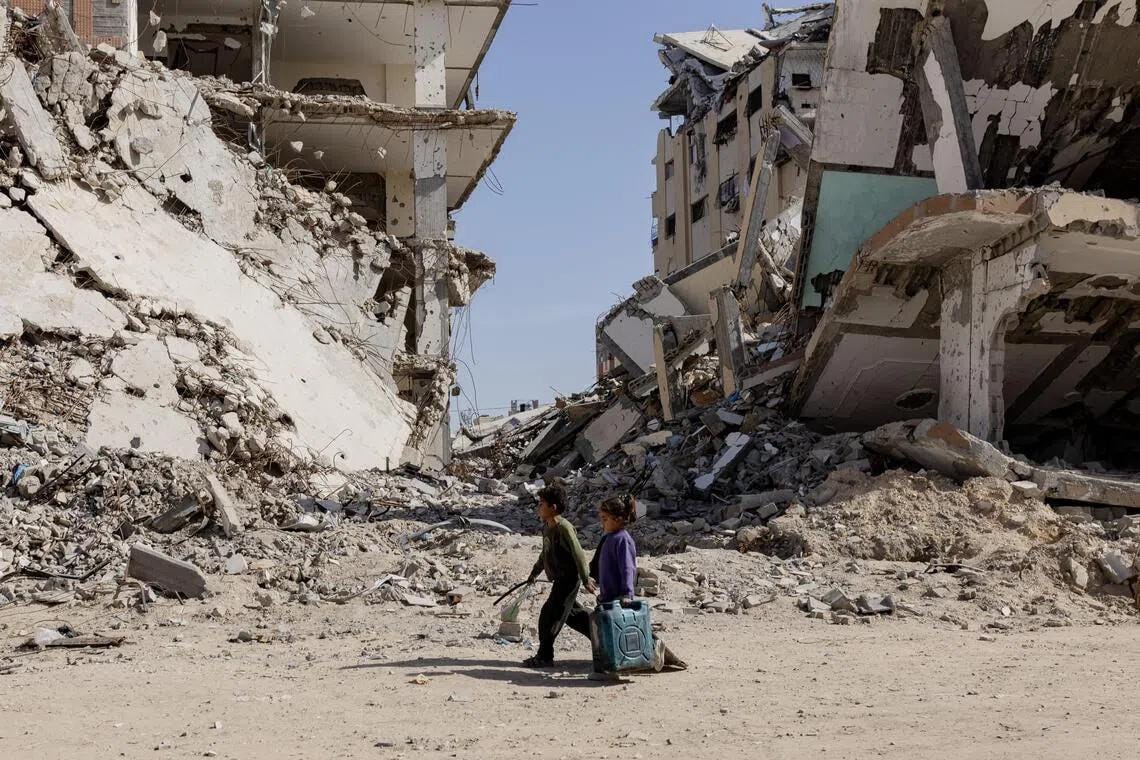
For Palestinians who have endured mass displacement, the deaths of family members and the destruction of their homes, far more is at stake than who gets appointed to govern Gaza. Who will decide what Palestinian children learn, how their religion is practiced, which parts of their history are preserved and what forms of political struggle remain legitimate — and how much authority will Palestinians themselves have over the future of their own society?
What happened to SELF-DETERMINATION?
Israel is the cause and Hamas is a symptom.
The proposed solution reminds me of why COMMUNISM was rejected. State control of everything, no free speech, brainwashing, surveillance etc., and allowing foreign countries to control that process is more revolting especially when one of those foreign powers is Israel and the other is USA.
Israel exists because SELF-DETERMINATION was denied to Palestinians by the United Nations yet somehow that is proposed as the solution to the Palestine problem!
The cause is Israel and if any reeducation or surveillance of people and their places of
religious worship is needed it is in Israel but a better solution is the dismantling of Israel and replacing it with a government for all of Palestine that treats all people as equal and respects International Law.
💔😢